博客

Collets vs Jaw Chucks: Precision Workholding for Small Diameters
Jun 04,2026

Collets vs Jaw Chucks: Precision Workholding for Small Diameters

For small-diameter bar work, collets beat jaw chucks on the two numbers that matter — centering and repeatability — because a collet grips the full circumference with a bore ground concentric to its cone, while a chuck localizes force at three or six jaws and carries more moving parts. Collets typically hold runout in the 0.005 mm class; jaw chucks on small diameters typically run an order of magnitude looser out of the box. Chucks win on grip range, raw clamping force and large diameters.

The collet-versus-chuck argument is really a diameter argument. Below roughly 25–30 mm, collets are the precision answer: they center better, repeat better and run truer because their geometry is simpler — a ground bore, a ground cone, and no jaw mechanisms to wear. Above that range, and whenever the work varies wildly in size, jaw chucks take over because they grip anything within their jaw travel and deliver clamping force no split collet matches. Picking the right one per job beats defending either side as a universal answer.

What Each System Actually Is

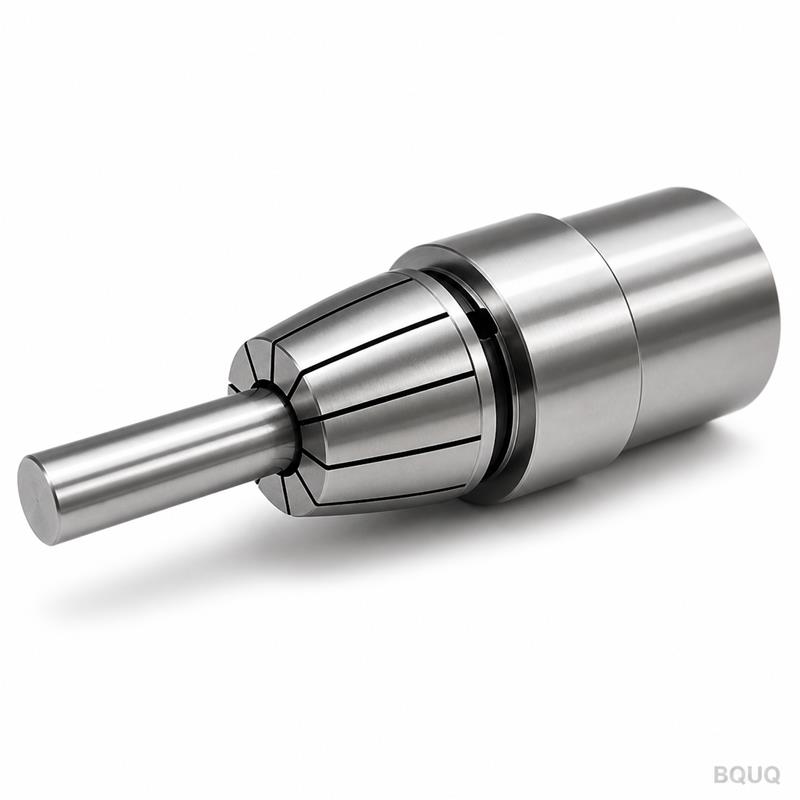
A collet workholding system is a tapered sleeve (or a chuck that holds one) closing onto the stock around its full circumference. In its simplest form — the spring collet on an automatic or Swiss lathe — the sleeve is drawn into a cone and the slotted fingers close evenly. The grip is continuous around the bar, and the bore that grips is the same surface that was ground concentric to the seating cone.

A jaw chuck is a mechanism: a scroll or wedge plate moves three, four or six jaws inward simultaneously. The jaws grip at discrete points or short arcs, and the mechanism between the actuation and the workpiece — scroll, slides, jaw mounting — carries clearance, wear and deflection that collets do not have.

PropertyCollet (spring)Jaw chuck (3-jaw self-centering)
Grip contactFull circumference3 points/arcs
Typical runout, small dia0.005–0.010 mm class0.02–0.05 mm typical, out of box
Grip rangeOne size ± small windowJaw travel, wide
Clamping forceModerate, drawtube-limitedHigh, mechanically multiplied
Moving partsNone (sleeve flexes)Scroll/wedge, jaws, slides
Wear itemsBore, coneJaw ways, scroll, jaws
Best diameter zoneSmall (roughly under 25–30 mm)Medium to large

Numbers are typical trade values, not a spec war — a ground and indicated chuck with soft jaws can approach collet runout, and a collet in a dirty taper can run worse than a good chuck. The structural point stands: the collet has fewer error sources.

Why Collets Center Better

Centering in a collet comes from geometry; centering in a chuck comes from a mechanism. The collet bore is ground in the same setup family as the seating cone, so when the cone seats, the bore sits on the spindle axis within the collet's runout class. Grip force is applied evenly around the circumference by fingers that flex equally — there is no jaw that grips harder on one side.

A jaw chuck centers by moving three jaws equal distances — which it does only as well as the scroll or wedge mechanism is manufactured and maintained. Jaw way wear, scroll backlash, and jaw mounting errors all add eccentricity, and the errors grow as jaws extend further from center. On small diameters, where the jaws are close to their inner limit, the mechanism's absolute errors become a large fraction of the part size.

Error sourceColletJaw chuck
Geometry of gripBore ground to coneJaw positions from mechanism
Wear effectSlow bore/cone wearScroll, ways, jaws all wear
Grip force symmetryEven by designDepends on jaw/scroll condition
Part size effectClass holds at any boreErrors grow at small diameters
Re-grip repeatabilityVery highGood to moderate

Repeatability: The Production Number

For production, repeatability often matters more than absolute accuracy: the part must come back to the same center every cycle, cycle after cycle. Collets are the benchmark here. The same collet gripping the same bar size returns to essentially the same position because nothing moves except the fingers' elastic flex, and the fingers return by spring action to the same bore.

Jaw chucks repeat well when healthy, but they repeat through a mechanism — and mechanisms drift. Jaws re-ground or re-cut, swarf in the scroll, and thermal changes in the chuck body all move the gripping center between cycles. For jobs that hold tenths on diameter and position, that drift is the difference between a stable process and one that needs constant adjustment. Where production mixes many part sizes on one machine, however, the chuck's instant range adjustment beats changing collets — which is why both live on the same shop floor.

Clamping Force and Rigidity

The jaw chuck's honest advantage is force. A wedge or lever chuck multiplies drawbar or hydraulic force into jaw clamping force that a split collet cannot match, and that force is what holds large or interrupted-cut work rigidly. Collets grip with the drawtube force distributed over the cone — adequate for bar-fed turning and finishing, marginal for heavy roughing of big sections.

The trade-off is marking and distortion. A collet spreads its (lower) grip force over the full circumference, so it marks soft or thin-wall stock less than jaws that concentrate force at three points. For thin-wall tube and finished surfaces, that makes the collet the gentler choice despite lower total force — force distribution, not just force magnitude, decides distortion.

Job characteristicCollet favoredJaw chuck favored
Bar diameters under ~25 mmStrongly
Large diametersStrongly
Wide size mix on one machineStrongly
Heavy roughing, interrupted cutsStrongly
Thin-wall / soft stockStrongly
Tenths-holding finish workStrongly
Quick changeover between parts— (if collet change is fast)Strongly

Grip Range: The Chuck's Decisive Win

Range is where the chuck simply has no rival. One 3-jaw chuck grips any bar within its jaw travel — from a few millimeters up to its capacity — while a collet grips one size plus a fraction of a millimeter. A job shop that machines a different diameter every hour cannot change collets every hour; it runs a chuck. A production line that runs the same bar for a year cannot justify a chuck's runout when a collet holds the tolerance for less cost.

The modern middle ground is the collet chuck: a chuck body that holds collets, giving the operator jaw-chuck mounting convenience with collet-class centering, and quick-change designs that swap collets in seconds. On automatic and Swiss lathes the collet chuck is the workholding standard; on general CNC lathes it is an option chosen when small-bar precision dominates the work. Our 2J collet chuck guide covers the most common collet-chuck family for Swiss and automatic machines.

Which Should You Buy?

Apply the diameter and mix test. If the work is bar under roughly 25–30 mm, holds tight tolerances, and runs in reasonable quantities, collets or a collet chuck are the precision answer — and on bar-fed machines there is no real choice, since the machine architecture requires collets. If the work is large, varied in size, or heavily interrupted, a jaw chuck is the practical answer, and its runout is managed with soft jaws and indicating rather than eliminated.

For shops that do both, the standard layout is a chuck for the range and a collet chuck for the precision bar jobs, swapped per setup. When the precision work dominates, buy the collet system first and keep the chuck for the odd sizes. BQUQ machines both sides of this decision — auto-lathe spring collets in the 36/46/52/60/630/643 families for the small-bar work, and Swiss/2J collet chucks for machines built around collet workholding — all ground to the 0.005 mm class under ISO9001 control in one Dongguan factory. See the auto-lathe collet range and the Swiss and 2J collet chucks, read the auto lathe collet guide for the family system, and send your part sizes and tolerances to sc@bquq.com for a recommendation and quote within 12 working hours.

Have a drawing? Get a factory quote within 12 hours.
Email sc@bquq.com or WhatsApp +86 137 1315 7787 with your PDF/DXF/STEP file. An engineer reviews it and replies with price, lead time and DFM notes on working days.

Frequently Asked Questions

Q: Why are collets more accurate than jaw chucks on small parts?

A: A collet grips with a bore ground concentric to its cone, with no mechanism between the seat and the work. A jaw chuck centers through a scroll or wedge with jaws, slides and wear — each adding error that matters most at small diameters.

Q: When should I use a jaw chuck instead of a collet?

A: When diameters are large, sizes change often, or the cut is heavy enough to need jaw-level clamping force. One chuck grips anything in its jaw travel; a collet grips one size. Range and force are the chuck's reasons to exist.

Q: Can a jaw chuck be as accurate as a collet?

A: With soft jaws bored in place and careful indicating, a chuck can approach collet accuracy for one specific part diameter. But it must be re-set for each new size, while the collet's accuracy is built in. Collets win on convenience and consistency.

Q: Do collets damage soft or thin-wall stock?

A: Less than jaws. A collet spreads its grip over the full circumference, so pressure is even; jaws concentrate force at three points. For thin-wall tube, a relieved collet bore can spread and soften the grip further.

Q: What is a collet chuck and how is it different from a jaw chuck?

A: A collet chuck is a chuck body that holds collets instead of jaws, combining quick mounting with collet-class centering. It grips one bar size per collet, so it suits production runs of consistent bar more than mixed-size jobbing.

Authored by the BQUQ Engineering Team. BQUQ is an ISO9001-certified source factory in Dongguan, China, running CNC machining, metal stamping, custom springs, heat sink and collet lines under one roof. Send drawings to sc@bquq.com or WhatsApp +86 13713157787 for a quote within 12 working hours. www.bquq.com


联系我们报价
获取报价
我们使用cookie来改善您的在线体验。继续浏览本网站即表示您同意我们使用cookie

Cookies

Please read our Terms and Conditions and this Policy before accessing or using our Services. If you cannot agree with this Policy or the Terms and Conditions, please do not access or use our Services. If you are located in a jurisdiction outside the European Economic Area, by using our Services, you accept the Terms and Conditions and accept our privacy practices described in this Policy.
We may modify this Policy at any time, without prior notice, and changes may apply to any Personal Information we already hold about you, as well as any new Personal Information collected after the Policy is modified. If we make changes, we will notify you by revising the date at the top of this Policy. We will provide you with advanced notice if we make any material changes to how we collect, use or disclose your Personal Information that impact your rights under this Policy. If you are located in a jurisdiction other than the European Economic Area, the United Kingdom or Switzerland (collectively “European Countries”), your continued access or use of our Services after receiving the notice of changes, constitutes your acknowledgement that you accept the updated Policy. In addition, we may provide you with real time disclosures or additional information about the Personal Information handling practices of specific parts of our Services. Such notices may supplement this Policy or provide you with additional choices about how we process your Personal Information.


Cookies

Cookies are small text files stored on your device when you access most Websites on the internet or open certain emails. Among other things, Cookies allow a Website to recognize your device and remember if you've been to the Website before. Examples of information collected by Cookies include your browser type and the address of the Website from which you arrived at our Website as well as IP address and clickstream behavior (that is the pages you view and the links you click).We use the term cookie to refer to Cookies and technologies that perform a similar function to Cookies (e.g., tags, pixels, web beacons, etc.). Cookies can be read by the originating Website on each subsequent visit and by any other Website that recognizes the cookie. The Website uses Cookies in order to make the Website easier to use, to support a better user experience, including the provision of information and functionality to you, as well as to provide us with information about how the Website is used so that we can make sure it is as up to date, relevant, and error free as we can. Cookies on the Website We use Cookies to personalize your experience when you visit the Site, uniquely identify your computer for security purposes, and enable us and our third-party service providers to serve ads on our behalf across the internet.

We classify Cookies in the following categories:
 ●  Strictly Necessary Cookies
 ●  Performance Cookies
 ●  Functional Cookies
 ●  Targeting Cookies


Cookie List
A cookie is a small piece of data (text file) that a website – when visited by a user – asks your browser to store on your device in order to remember information about you, such as your language preference or login information. Those cookies are set by us and called first-party cookies. We also use third-party cookies – which are cookies from a domain different than the domain of the website you are visiting – for our advertising and marketing efforts. More specifically, we use cookies and other tracking technologies for the following purposes:

Strictly Necessary Cookies
These cookies are necessary for the website to function and cannot be switched off in our systems. They are usually only set in response to actions made by you which amount to a request for services, such as setting your privacy preferences, logging in or filling in forms. You can set your browser to block or alert you about these cookies, but some parts of the site will not then work. These cookies do not store any personally identifiable information.

Functional Cookies
These cookies enable the website to provide enhanced functionality and personalisation. They may be set by us or by third party providers whose services we have added to our pages. If you do not allow these cookies then some or all of these services may not function properly.

Performance Cookies
These cookies allow us to count visits and traffic sources so we can measure and improve the performance of our site. They help us to know which pages are the most and least popular and see how visitors move around the site. All information these cookies collect is aggregated and therefore anonymous. If you do not allow these cookies we will not know when you have visited our site, and will not be able to monitor its performance.

Targeting Cookies
These cookies may be set through our site by our advertising partners. They may be used by those companies to build a profile of your interests and show you relevant adverts on other sites. They do not store directly personal information, but are based on uniquely identifying your browser and internet device. If you do not allow these cookies, you will experience less targeted advertising.

How To Turn Off Cookies
You can choose to restrict or block Cookies through your browser settings at any time. Please note that certain Cookies may be set as soon as you visit the Website, but you can remove them using your browser settings. However, please be aware that restricting or blocking Cookies set on the Website may impact the functionality or performance of the Website or prevent you from using certain services provided through the Website. It will also affect our ability to update the Website to cater for user preferences and improve performance. Cookies within Mobile Applications

We only use Strictly Necessary Cookies on our mobile applications. These Cookies are critical to the functionality of our applications, so if you block or delete these Cookies you may not be able to use the application. These Cookies are not shared with any other application on your mobile device. We never use the Cookies from the mobile application to store personal information about you.

If you have questions or concerns regarding any information in this Privacy Policy, please contact us by email at . You can also contact us via our customer service at our Site.