2J Collet Chucks: The Workhorse for Swiss and Automatic Lathes
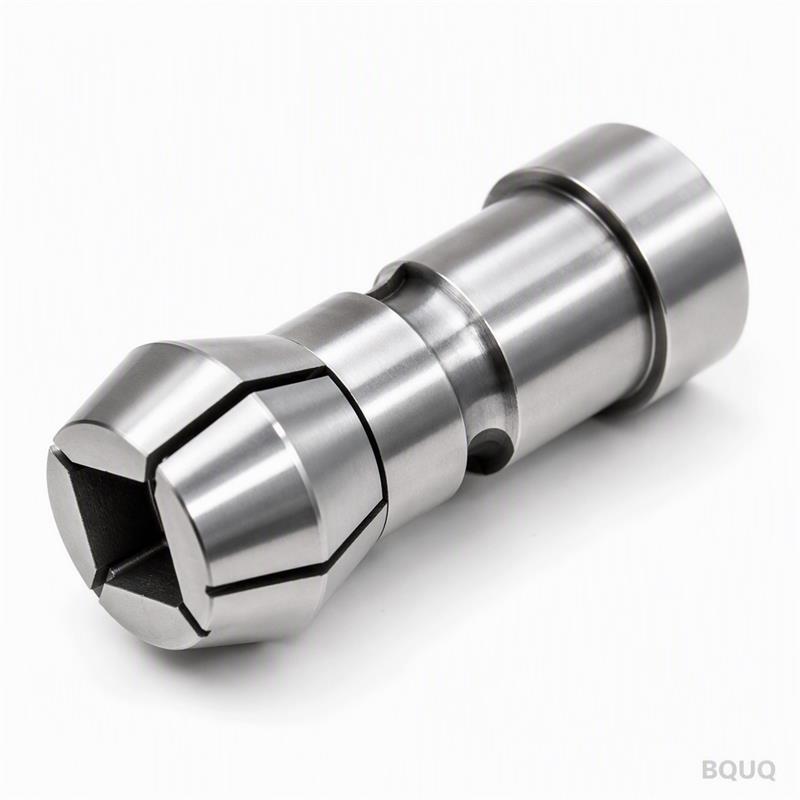
A 2J collet chuck is the standard workholding package for Swiss-type and automatic lathes: a chuck body that mounts to the spindle nose, accepts the full family of 2J collets, and opens and closes them through the machine's draw tube. It earns the workhorse label because one chuck body plus a shelf of 2J collets covers a wide bar range with quick changeovers and repeatable concentricity.
Ask any shop running Swiss-type or cam automatic lathes what holds the bar and the answer is usually the same: a 2J system. The collet family is compact, the chuck bodies are proven, and the economics are simple — you buy the chuck once and then buy only the small, cheap collets for each new bar size. This guide covers what a 2J chuck is, what to check when you buy or spec one, and how it behaves on the machine.
What a 2J Collet Chuck Contains
A 2J collet chuck is a machined steel body with three jobs: mount to the machine spindle, seat the collet concentrically, and transfer draw-tube force to the collet's closing taper. The typical anatomy is a flange or threaded back that matches the spindle nose, a precision bore and taper that locate the collet, and a nut or cap that holds the collet in place while the draw tube pulls it into the taper to grip.
Because the chuck body is the precision reference for everything downstream, its machining quality sets the ceiling on your runout. A chuck whose collet seat is eccentric or whose taper is out of round will pass that error to every part it grips, no matter how good the collet is. That is why the seat and taper should be ground or machined on CNC equipment with verification, not eyeballed — BQUQ machines its 2J-type Swiss collet chucks on CNC turning centers and holds the locating surfaces to a 0.005 mm class before the collets are ever fitted.
Capacity and Coverage
The 2J family covers round bar from small diameters up to roughly 38 mm at the top of the range, with inch bores stepped in 1/64 in and metric bores commonly stepped in 0.5 mm. Hex and square stock reduce usable capacity, and thin-walled or soft materials may need a dedicated bore at exact size rather than a near-size bore. A realistic coverage plan looks like this:
| Stock shape | Typical max size in 2J | Bore strategy |
|---|---|---|
| Round, general turning | ~38 mm (1-1/2 in) | Order bore 0.03–0.08 mm over stock, confirm fit |
| Hex | ~70–80% of round max | Match across flats, check corner clearance |
| Square | ~60–70% of round max | Match across flats, watch edge marking |
| Soft or thin-wall tube | Below system max | Exact-size bore, reduced collapse |
The pattern is the point: capacity is not one number, it is a function of shape and material. A 2J collet grips over a small range — typically a few hundredths of a millimeter of collapse — so it must be ordered to the actual stock diameter, not a nominal one. When stock varies more than the collet can absorb, you see it as grip loss or out-of-round parts, not as a collet defect.
How a 2J Chuck Behaves on the Machine
Two behaviors define the 2J chuck in operation. First, it is a through-bore system: the bar passes through the chuck and spindle, which is exactly what a sliding-headstock Swiss machine needs for feeding. Second, its axial behavior depends on the collet and chuck design — the difference between dead-length and pull-back action, covered fully in our comparison of dead-length vs pull-back collets.
In simple terms: a pull-back action draws the bar axially toward the spindle as the collet closes, which is fine when parts are cut against a stop or length control is loose; a dead-length action closes the collet without moving the bar axially, which matters when you are feeding stock and cutting to length repeatedly. For Swiss-type work, where every part's length depends on the bar staying put when the collet re-grips, dead-length behavior is usually the right call. Ask your chuck supplier which action their body produces before you commit, not after you measure drift on the first batch.
The table below summarizes the operating differences you will actually feel on the floor:
| Behavior | What happens when closing | Best suited to | Watch out for |
|---|---|---|---|
| Pull-back | Collet draws bar toward spindle | Parts faced against a stop | Length drift on re-grip |
| Dead-length | Collet collapses in place | Bar-fed Swiss and auto work | Requires accurate seating |
| Standard taper | Collet pulled into chuck taper | General turning | Runout depends on taper cleanliness |
Buying and Setting Up a 2J Chuck
When you spec a 2J chuck, check five things. The spindle mount must match your machine — flange or thread, and the correct nose size. The through-bore must clear your largest bar plus a little for swarf. The collet seat must be concentric and the closing taper clean and unmarked. The actuation must suit your draw tube force and stroke. And the collets must be stocked in the bores you actually run — there is no point owning a precision chuck with three mismatched collets.
Installation is straightforward but unforgiving: clean the spindle nose and chuck mounting face, torque the mounting fasteners evenly, and indicate the chuck's seat or a test collet. Our collet chuck installation guide gives the full torque and seating procedure. If you are starting from scratch on a Swiss or automatic line, the BQUQ engineering team can match chucks and auto-lathe collets to your stock list — send the bar sizes and spindle details to sc@bquq.com and get a quotation within 12 working hours.
Email sc@bquq.com or WhatsApp +86 137 1315 7787 with your PDF/DXF/STEP file. An engineer reviews it and replies with price, lead time and DFM notes on working days.
Frequently Asked Questions
Q: What bar sizes can a 2J collet chuck hold?
A: The chuck holds whatever 2J collets you fit, and the family covers round bar from small diameters up to roughly 38 mm at the top of the range. Each collet is ordered to a specific stock size, so coverage depends on the collets you stock.
Q: Is a 2J collet chuck dead-length?
A: It depends on the chuck and collet design, not the 2J name alone. Some 2J arrangements pull the bar back as they close; dead-length versions close without axial movement. Swiss-type feeding work usually wants dead-length action.
Q: Can one 2J chuck handle hex and square stock?
A: Yes, with the right collet bores. Hex and square bores reduce usable capacity — typically to 60–80% of the round maximum — and must be matched to the stock across flats with corner clearance checked.
Q: How much runout should I expect from a 2J system?
A: With a clean taper, a correctly seated collet and straight stock, a well-machined chuck holds concentricity in the 0.005 mm class at the collet nose. Measure with a ground test bar and indicator at the nose and again 25–50 mm out.
Q: Why does my 2J collet not close fully on some bars?
A: Most likely the bore is undersized for the actual stock, or the taper seat is dirty, or the draw-tube stroke is set short. Measure the bar, clean the taper, and verify full collet stroke before suspecting the chuck itself.
Authored by the BQUQ Engineering Team. BQUQ is an ISO9001-certified source factory in Dongguan, China, running CNC machining, metal stamping, custom springs, heat sink and collet lines under one roof. Send drawings to sc@bquq.com or WhatsApp +86 13713157787 for a quote within 12 working hours. www.bquq.com