博客

Dead-Length vs Pull-Back Collets: Where the Part Moves Matters
Jun 18,2026

Dead-Length vs Pull-Back Collets: Where the Part Moves Matters

The difference between a dead-length and a pull-back collet is one number: how far the part moves along the spindle axis when the collet closes. A pull-back collet retracts the work a few tenths of a millimeter as it grips; a dead-length collet collapses in place so the work's axial position does not change. On bar-fed lathes that single behavior decides whether your part lengths repeat.

Two otherwise identical machines can produce very different parts purely because of how their collets close. If you are cutting parts to a length that matters — and on Swiss-type and automatic lathes nearly every part's length matters — the axial movement of the collet is a design decision, not a detail. This guide explains what each action does, where each belongs, and how to read a collet or chuck catalog so you order the behavior your process needs.

What Happens When Each Collet Closes

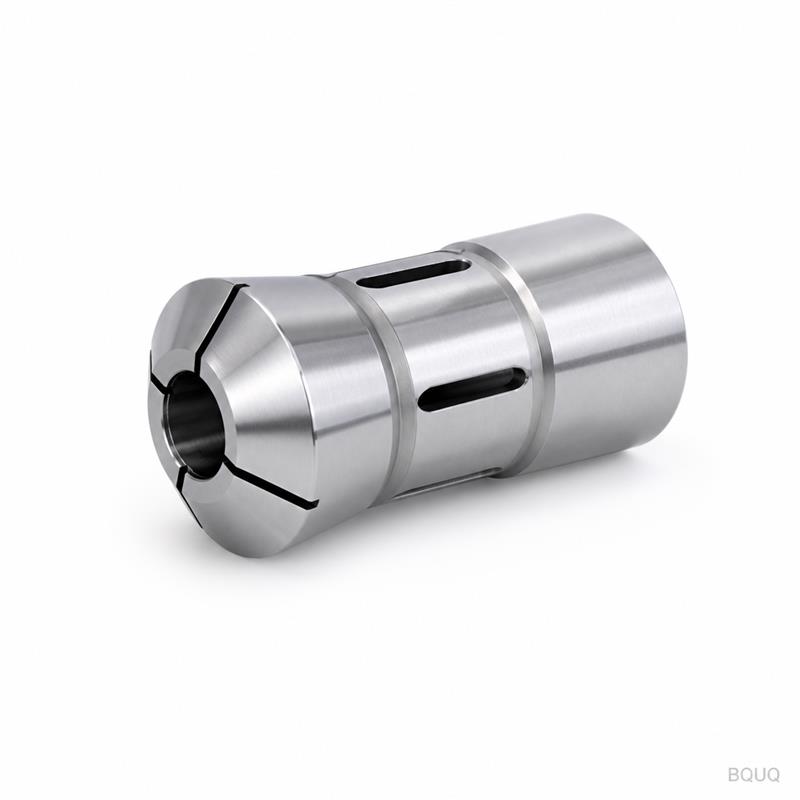
Picture a collet gripping a bar. The collet nose is pulled into a tapered seat, and the tapered segments squeeze inward onto the stock. The question is what the taper does to the bar's axial position while the segments close.

In a pull-back design the collet body itself moves toward the spindle as it is drawn into the taper, carrying the bar with it. The work retracts by the distance the collet travels — commonly from a few hundredths up to a few tenths of a millimeter depending on collet size, taper angle and stroke. In a dead-length design the collet body is held against axial movement; only the gripping segments collapse radially, so the bar stays at the same Z position whether the collet is open or closed.

BehaviorAxial movement at closeWhat it does to the part
Pull-back0.05–0.4 mm typicalDraws work back against stop or datum; changes free length
Dead-length~0 (segments collapse only)Holds Z position; length repeats after each re-grip

The movement values are typical ranges, not specifications — they scale with collet size and stroke. The table's real message: a pull-back collet actively seats the work against something, and a dead-length collet preserves the position you set.

When Pull-Back Is the Right Choice

Pull-back action is not a flaw; it is a feature in the right job. Because the closing motion pulls the bar toward the spindle, a pull-back collet can seat the work firmly against a fixed stop or chuck datum, removing gaps and giving the front face a reliable reference. That makes pull-back the natural choice for:

  • Parts faced or machined against an end stop, where seating is the priority
  • Conventional CNC lathes cutting short slugs from bar with a stop in the spindle
  • Jobs where a small axial shift is acceptable because the next operation re-locates the part

The trade-off shows up when the bar is not held against a stop — for example feeding stock through a Swiss machine or a bar puller on a CNC lathe. Every close retracts the bar a little, and if the grip point varies, so does the part length. Pull-back also tends to give slightly higher effective grip for a given actuation force, because the axial motion adds a seating component to the radial squeeze.

When Dead-Length Wins

Dead-length collets exist for the jobs where axial position is the specification. In Swiss-type machining the headstock feeds the bar, the collet opens and closes to advance stock, and every part is cut to a length measured from a known position. If the collet pulled the bar back each time it gripped, length control would drift with every feed. Dead-length action removes that variable.

The same logic applies on automatic lathes and on CNC turning when you are machining to length without a physical stop. Our guide to 2J collet chucks notes that Swiss-type feeding work usually wants dead-length behavior; this is why. The practical comparison:

RequirementPull-back colletDead-length collet
Length repeatability after re-gripDepends on stop and strokeHigh — position preserved
Seating against an end stopExcellentRequires separate seating step
Bar feeding accuracyDrift risk per cycleStable per cycle
Typical grip for same draw forceSlightly higherSlightly lower, must be sized correctly
Setup complexitySimpler on stop-workRequires accurate collet seating

Pick the table row that your part actually depends on. If a customer rejects parts for length spread, switch the workholding before you touch the program.

Ordering the Behavior You Need

Collet and chuck catalogs do not always say "dead-length" in plain words. Look for terms like "non-pull-back," "stationary" or "dead-length" on collets, and on chucks for construction details — a dead-length chuck usually holds the collet body against the spindle while a separate sleeve or wedge collapses the segments. When in doubt, ask the supplier to state the axial movement of the work at full close, in millimeters. A supplier that cannot answer that number has not measured their own product.

For custom work the same logic applies to the collet itself: a collet machined from hardened spring steel with the right slit pattern will flex radially as designed, but its axial behavior comes from the chuck that seats it. BQUQ machines auto-lathe spring collets and Swiss-type collet chucks as matched pairs, with locating surfaces held to a 0.005 mm class so the behavior you design is the behavior you get on the machine. Installation and seating procedure details are in our collet chuck installation guide.

Have a drawing? Get a factory quote within 12 hours.
Email sc@bquq.com or WhatsApp +86 137 1315 7787 with your PDF/DXF/STEP file. An engineer reviews it and replies with price, lead time and DFM notes on working days.

Frequently Asked Questions

Q: How much does a pull-back collet move the part?

A: Typically a few hundredths to a few tenths of a millimeter, depending on collet size, taper angle and draw stroke. It is measurable — put an indicator on the bar end and cycle the collet to see your exact value.

Q: Is dead-length always better than pull-back?

A: No. Pull-back seats work firmly against a stop and gives slightly higher grip for the same force. Dead-length wins when axial position must repeat, like bar feeding and length-critical Swiss work. Match the behavior to the operation.

Q: Can I convert a pull-back chuck to dead-length?

A: Sometimes, by fitting a dead-length collet or a chuck insert that holds the collet axially while collapsing the segments. It depends on the chuck construction — check with the maker before buying parts, since not all bodies accept the conversion.

Q: Why do my part lengths drift between batches?

A: Check the collet's axial behavior first. If it pulls back on each grip and the bar is not seated against a stop, every cycle shifts the zero point. Also check bar straightness, collet bore fit and draw-tube stroke repeatability.

Q: Does dead-length action reduce gripping force?

A: Slightly, for the same draw force, because the axial seating component is removed. In practice the collet is sized to the stock so radial collapse alone provides ample grip — undersized bores cause more grip problems than dead-length design does.

Authored by the BQUQ Engineering Team. BQUQ is an ISO9001-certified source factory in Dongguan, China, running CNC machining, metal stamping, custom springs, heat sink and collet lines under one roof. Send drawings to sc@bquq.com or WhatsApp +86 13713157787 for a quote within 12 working hours. www.bquq.com


联系我们报价
获取报价
我们使用cookie来改善您的在线体验。继续浏览本网站即表示您同意我们使用cookie

Cookies

Please read our Terms and Conditions and this Policy before accessing or using our Services. If you cannot agree with this Policy or the Terms and Conditions, please do not access or use our Services. If you are located in a jurisdiction outside the European Economic Area, by using our Services, you accept the Terms and Conditions and accept our privacy practices described in this Policy.
We may modify this Policy at any time, without prior notice, and changes may apply to any Personal Information we already hold about you, as well as any new Personal Information collected after the Policy is modified. If we make changes, we will notify you by revising the date at the top of this Policy. We will provide you with advanced notice if we make any material changes to how we collect, use or disclose your Personal Information that impact your rights under this Policy. If you are located in a jurisdiction other than the European Economic Area, the United Kingdom or Switzerland (collectively “European Countries”), your continued access or use of our Services after receiving the notice of changes, constitutes your acknowledgement that you accept the updated Policy. In addition, we may provide you with real time disclosures or additional information about the Personal Information handling practices of specific parts of our Services. Such notices may supplement this Policy or provide you with additional choices about how we process your Personal Information.


Cookies

Cookies are small text files stored on your device when you access most Websites on the internet or open certain emails. Among other things, Cookies allow a Website to recognize your device and remember if you've been to the Website before. Examples of information collected by Cookies include your browser type and the address of the Website from which you arrived at our Website as well as IP address and clickstream behavior (that is the pages you view and the links you click).We use the term cookie to refer to Cookies and technologies that perform a similar function to Cookies (e.g., tags, pixels, web beacons, etc.). Cookies can be read by the originating Website on each subsequent visit and by any other Website that recognizes the cookie. The Website uses Cookies in order to make the Website easier to use, to support a better user experience, including the provision of information and functionality to you, as well as to provide us with information about how the Website is used so that we can make sure it is as up to date, relevant, and error free as we can. Cookies on the Website We use Cookies to personalize your experience when you visit the Site, uniquely identify your computer for security purposes, and enable us and our third-party service providers to serve ads on our behalf across the internet.

We classify Cookies in the following categories:
 ●  Strictly Necessary Cookies
 ●  Performance Cookies
 ●  Functional Cookies
 ●  Targeting Cookies


Cookie List
A cookie is a small piece of data (text file) that a website – when visited by a user – asks your browser to store on your device in order to remember information about you, such as your language preference or login information. Those cookies are set by us and called first-party cookies. We also use third-party cookies – which are cookies from a domain different than the domain of the website you are visiting – for our advertising and marketing efforts. More specifically, we use cookies and other tracking technologies for the following purposes:

Strictly Necessary Cookies
These cookies are necessary for the website to function and cannot be switched off in our systems. They are usually only set in response to actions made by you which amount to a request for services, such as setting your privacy preferences, logging in or filling in forms. You can set your browser to block or alert you about these cookies, but some parts of the site will not then work. These cookies do not store any personally identifiable information.

Functional Cookies
These cookies enable the website to provide enhanced functionality and personalisation. They may be set by us or by third party providers whose services we have added to our pages. If you do not allow these cookies then some or all of these services may not function properly.

Performance Cookies
These cookies allow us to count visits and traffic sources so we can measure and improve the performance of our site. They help us to know which pages are the most and least popular and see how visitors move around the site. All information these cookies collect is aggregated and therefore anonymous. If you do not allow these cookies we will not know when you have visited our site, and will not be able to monitor its performance.

Targeting Cookies
These cookies may be set through our site by our advertising partners. They may be used by those companies to build a profile of your interests and show you relevant adverts on other sites. They do not store directly personal information, but are based on uniquely identifying your browser and internet device. If you do not allow these cookies, you will experience less targeted advertising.

How To Turn Off Cookies
You can choose to restrict or block Cookies through your browser settings at any time. Please note that certain Cookies may be set as soon as you visit the Website, but you can remove them using your browser settings. However, please be aware that restricting or blocking Cookies set on the Website may impact the functionality or performance of the Website or prevent you from using certain services provided through the Website. It will also affect our ability to update the Website to cater for user preferences and improve performance. Cookies within Mobile Applications

We only use Strictly Necessary Cookies on our mobile applications. These Cookies are critical to the functionality of our applications, so if you block or delete these Cookies you may not be able to use the application. These Cookies are not shared with any other application on your mobile device. We never use the Cookies from the mobile application to store personal information about you.

If you have questions or concerns regarding any information in this Privacy Policy, please contact us by email at . You can also contact us via our customer service at our Site.