Machining Titanium: What a CNC Shop Needs to Hold Tight Tolerances
A well-set-up CNC shop holds ±0.01 mm on titanium every day; a sloppy one scrapes parts at ±0.05 mm. Titanium is not slow because it is hard — it is slow because it is tough, springy, and holds heat in the cut zone. That combination punishes flexible tooling, timid feeds, and shops that treat titanium like stainless steel.
Titanium is a growth metal for medical implants, aerospace brackets, robotics frames, and high-end consumer parts precisely because it is strong per gram and biocompatible. It is also one of the least forgiving materials a CNC program can touch. Before you send a titanium drawing out for quote, it helps to know what the shop is fighting, what the grades actually cost you, and which tolerance callouts are realistic on a machined surface versus a ground one.
Why Titanium Punishes the Cutting Edge
The machining difficulty of titanium comes from four physical facts, not from hardness numbers. Its thermal conductivity is around 7 W/m·K — roughly one seventh of steel and one twentieth of aluminum — so the heat of cutting stays in the tool tip instead of leaving with the chip. Its modulus of elasticity is low, about 114 GPa, so thin sections deflect away from the cutter and spring back after the pass. It work-hardens quickly, which means a tool that rubs instead of cuts immediately creates a hardened skin that ruins the next edge. And its chips are thin and strong, concentrating load on a very small length of cutting edge.
Those four facts set the machining rules. Cutting speed must stay low, feed must stay high enough to cut under the work-hardened layer, and the tool must never dwell. Shops that do not respect this burn through carbide at a rate that shows up directly in your quote.
Titanium Grades You Will Actually Machine
Not all titanium machines the same. Grade 2 is the common commercially pure alloy; Grade 5 — Ti-6Al-4V — is the workhorse for structural parts; Grades 9 and 23 are the specialized versions for tubing, hydraulics, and medical work. The table below gives typical properties, so treat the numbers as ranges rather than datasheet absolutes.
| Grade | Nominal tensile strength | Typical use | Relative machinability vs Grade 5 |
|---|---|---|---|
| Grade 2 (CP) | ~345 MPa | Sheet, chemical, marine hardware | Slightly easier, gummy chips |
| Grade 5 (Ti-6Al-4V) | ~900–1000 MPa | Aerospace, robotics, structural CNC parts | Baseline |
| Grade 9 (Ti-3Al-2.5V) | ~620 MPa | Hydraulic tubing, pressure parts | Similar to Grade 5 |
| Grade 23 (Ti-6Al-4V ELI) | ~895 MPa | Medical implants, cryogenic | Similar, tighter lot control |
Grade choice moves cost more than most buyers expect. The raw material price of Grade 5 already sits well above stainless, and ELI-grade billet for medical work adds traceability and lot documentation on top. If your part does not need the bio-rating or the fatigue pedigree, Grade 5 is usually the honest default, and CP Grade 2 is worth a look for formed or lightly loaded parts.
What the Machine and Tooling Need to Hold ±0.01 mm
Holding tight tolerance on titanium is mostly a rigidity problem. The machine needs enough torque to keep speed low and feed steady without stalling; a light-duty spindle that bogs down mid-cut leaves a witness mark on the surface. Tooling should be short and stubby — overhang is deflection, and deflection is where tolerance goes to die.
| Machining variable | Typical range for Ti-6Al-4V | Why it matters |
|---|---|---|
| Cutting speed (turning, carbide) | 30–70 m/min | Above this, edge life collapses |
| Feed (rough turning) | 0.15–0.3 mm/rev | Must stay above work-hardening threshold |
| Depth of cut (roughing) | 1–3 mm | Deep enough to cut under the hardened skin |
| Coolant | High-pressure flood or through-spindle | Must reach the cutting edge, not the chip pile |
| Tool coating | AlTiN or similar | Resists the heat at the interface |
The practical takeaway: expect cycle times on titanium of roughly three to five times what the same part would take in 6061 aluminum, plus heavier tool wear. That is not a shop being slow; it is the material. A quote that promises aluminum-style speeds on titanium is a quote that will fail in production, usually right after the first tool change.
Where Tolerance Breaks on Titanium Parts
Most titanium tolerance failures are not the machine's positioning. They are thermal and mechanical. A long thin shaft machined at high removal rates will grow from heat and measure oversize until it cools. Thin-wall tubes deflect during the cut and spring back to a different shape than the tool path implied. Deep features let the tool deflect, producing taper. Part holding matters as much as the cut — soft jaws, steady rests, and supports placed at the right stations are what keep a 0.5 mm wall from chattering.
That is why a responsible supplier quotes the drawing, not the material name. The same Ti-6Al-4V part at 60 mm long with a 3 mm through-hole is a very different job from a 150 mm cantilevered arm. When tolerances sit at ±0.01 mm or tighter, ask how the shop plans to hold the part, how they manage heat, and whether critical diameters are turned in one setup. If you want to see how positioning accuracy and repeatability are judged before parts ship, our write-up on CNC accuracy vs repeatability explains the two numbers that actually decide yield.
Reading a Titanium Part Drawing Like a Buyer
Practical drawing advice for titanium, in the order it affects your quote:
- Call tolerance only on features that mate or rotate. Titanium's thermal expansion, around 8.6 µm/m·K, means an unconstrained 100 mm feature can move more than a micron per 10°C of shop temperature change — a cosmetic face does not need ±0.01 mm.
- Specify finish for threads and faying surfaces honestly. Ground diameters on titanium are a separate, more expensive operation; do not ask for ground finishes on turned surfaces that will never see a bearing.
- Provide the grade and condition (annealed, mill-annealed, ELI). "Titanium" alone forces the shop to assume the most expensive interpretation.
- Tell the shop what the part does. Knowing a feature carries load or seats a seal changes how they program the finish pass.
Every batch of titanium parts we ship includes a dimensional inspection report, and critical features are verified on a CMM — the same discipline described in our guide to reading CMM inspection reports. If you are evaluating a supplier for titanium work, ask for a sample batch report and check the deviation column yourself.
Where Titanium Fits in Your Cost Model
Raw titanium billet commonly costs ten to twenty-five times as much per kilogram as 6061 aluminum, and machining time runs three to five times longer. That combination means a titanium part is not a small premium — it is usually a different budget line. It earns its cost only where the application needs the strength-to-weight ratio, corrosion resistance, biocompatibility, or fatigue life. For everything else, 7075 aluminum or 17-4PH stainless gets you most of the way at a fraction of the price.
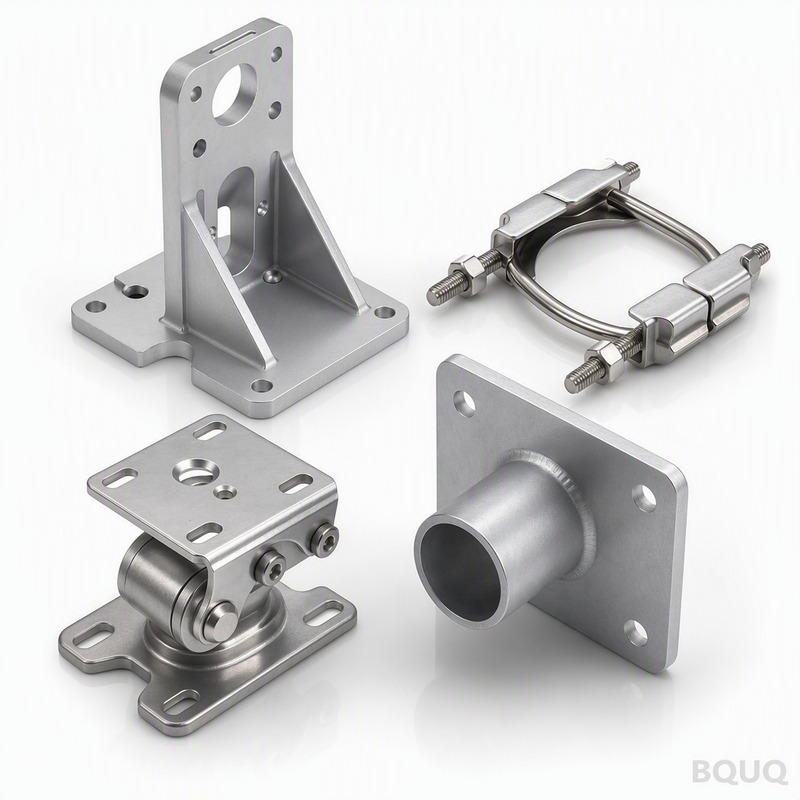
When the application does genuinely need titanium, machining it well is routine — it is just a question of experience, rigidity, and honest quoting. We machine titanium components in production on our CNC precision components line and CNC turning cells, and the questions we ask before quoting are exactly the ones above. Send the drawing with the grade and functional notes, and the quote you get back will reflect the real part, not a cautious guess.
Email sc@bquq.com or WhatsApp +86 137 1315 7787 with your PDF/DXF/STEP file. An engineer reviews it and replies with price, lead time and DFM notes on working days.
Frequently Asked Questions
Q: What tolerance can CNC machining actually hold on titanium?
A: With rigid fixturing, low speeds, and stable temperature, ±0.01 mm is achievable on machined features, and ±0.005 mm on short, well-supported diameters. Ground features go tighter still. Loose setups or long thin sections push real capability to ±0.05 mm or worse.
Q: Why is machining titanium so expensive compared to aluminum?
A: Two compounding reasons: raw billet costs roughly 10–25× more per kilogram than 6061 aluminum, and cycle times run 3–5× longer because cutting speeds must stay near 30–70 m/min with heavier tool wear. Both appear line by line in a real quote.
Q: Do I need Ti-6Al-4V ELI (Grade 23) for every titanium part?
A: No. ELI grade carries extra purity control and documentation for medical implant and cryogenic work, and it costs more. For structural aerospace-style or robotics parts, standard Grade 5 is usually the correct, cheaper choice.
Q: Can titanium parts be anodized or coated?
A: Yes. Titanium can be anodized for color or wear resistance, and common coatings like AlTiN apply to tools rather than parts. If you need a specific surface treatment, state it on the drawing so the finish allowance is planned before machining, not after.
Q: How should I send a titanium part for quoting?
A: Send the 3D model or 2D drawing with the titanium grade, condition, quantity, and any functional notes to sc@bquq.com or WhatsApp +86 13713157787. BQUQ returns a quotation within 12 working hours on working days.
Authored by the BQUQ Engineering Team. BQUQ is an ISO9001-certified source factory in Dongguan, China, running CNC machining, metal stamping, custom springs, heat sink and collet lines under one roof. Send drawings to sc@bquq.com or WhatsApp +86 13713157787 for a quote within 12 working hours. www.bquq.com