Compression, Extension or Torsion: Choose the Spring Type First
Choose the spring type from the load direction, not from habit: a part that must be pushed apart takes a compression spring, a part that must be pulled together takes an extension spring, and a part that must be rotated back takes a torsion spring. Compression springs are the cheapest and most reliable default; extension springs add hooks that become the weak point; torsion springs carry their load in bending through arms — choose them only when the motion is angular.
Three out of four custom spring inquiries I see are answered by the same first question: what motion is the spring resisting? Springs store energy by being deflected from a free shape, and each type is naturally loaded in one direction. Compression springs are squeezed along their axis, extension springs are stretched along their axis, torsion springs are wound around their axis. When the mechanism's motion matches the spring's natural loading, the design is simple and the spring is reliable. When they conflict, engineers bolt on adapters and the failure rate climbs.
Compression Springs: The Default for a Reason
Compression springs push things apart. They are the most common spring type because pushing is the most common spring job, and they are the cheapest and most forgiving to make: no hooks to form, no end connections to fail, load introduced through flat or closed ends. They need lateral guidance when they get long relative to their diameter — a rod through the middle or a bore around them — because a slender compression spring buckles sideways past a length-to-diameter ratio of roughly 4:1.
| Spring type | Load direction | Typical space need | Main weakness |
|---|---|---|---|
| Compression | Push along axis | Needs axial room, can nest | Buckling if slender and unguided |
| Extension | Pull along axis | Needs axial room plus end space | Hooks are the failure point |
| Torsion | Rotational moment | Radial room for arms | High stress in arms, coil friction |
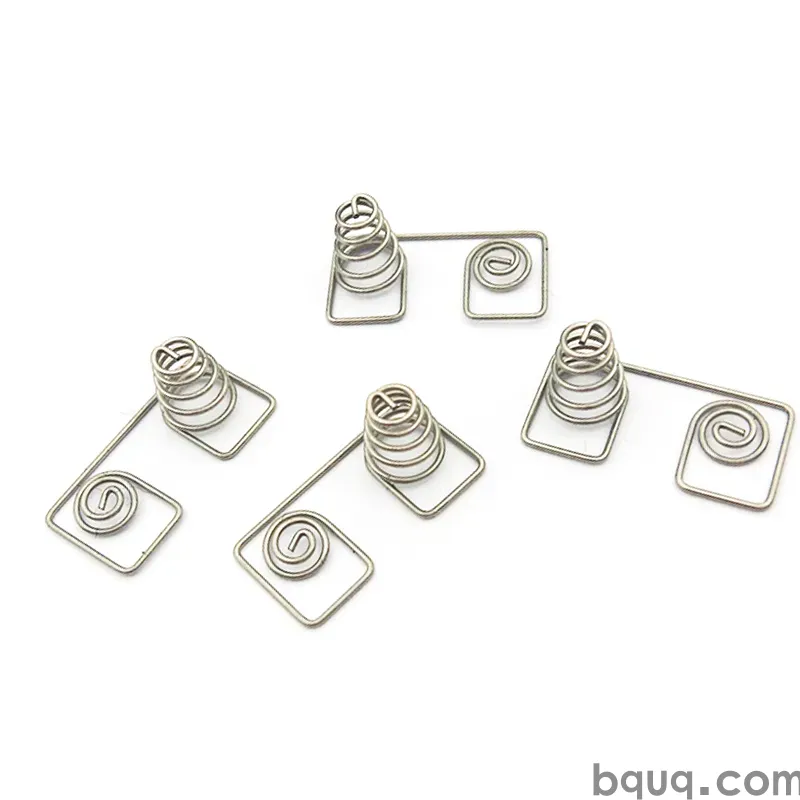
| Conical compression | Push, short solid height | Little compressed height | Progressive rate, more cost |
| Constant force / leaf | Push over long travel | Flat space | Specialized, custom tooling |
Takeaway: if the mechanism pushes and has axial room, use a plain compression spring — specify load at working height, keep the length-to-diameter ratio under about 4:1 or add a guide, and the design is done. Compression springs also tolerate the widest tolerance classes, which keeps cost down. Most "which type" questions resolve here.
Extension Springs: When the Motion Is a Pull
Extension springs pull things together — latch returns, counterbalances, tensioners. They are coils wound tight enough to have initial tension: the force needed to start separating the coils, typically 10–25% of the full load for a spring wound with close pitch. That initial tension is a feature (it holds the mechanism snug at rest) and a trap (if the drawing ignores it, the free length and the load at working length disagree with reality). The defining weakness is the ends: every load passes through hooks formed in the wire, and as covered in the extension spring hook guide, the hook carries higher stress than the body and fails first.
| Design factor | Extension spring value |
|---|---|
| Initial tension | 10–25% of maximum load, typical |
| Load path | Through hooks — bend stress at ends |
| End forms | Full loop, German loop, side hook, mechanical ends |
| Space | Needs axial travel plus hook clearance |
| Fatigue | Hook-limited unless mechanical ends used |
Takeaway: choose extension only when the mechanism genuinely pulls. Then design the end connection first — hook geometry, radius and clearance — because that decides life. If the pull is heavy or highly cyclic, ask about mechanical ends (plugs, threaded inserts) that remove the hook weakness; the extension spring line covers both coiled-with-hook and mechanical-end builds.
Torsion Springs: Angular Motion, Bending Loads
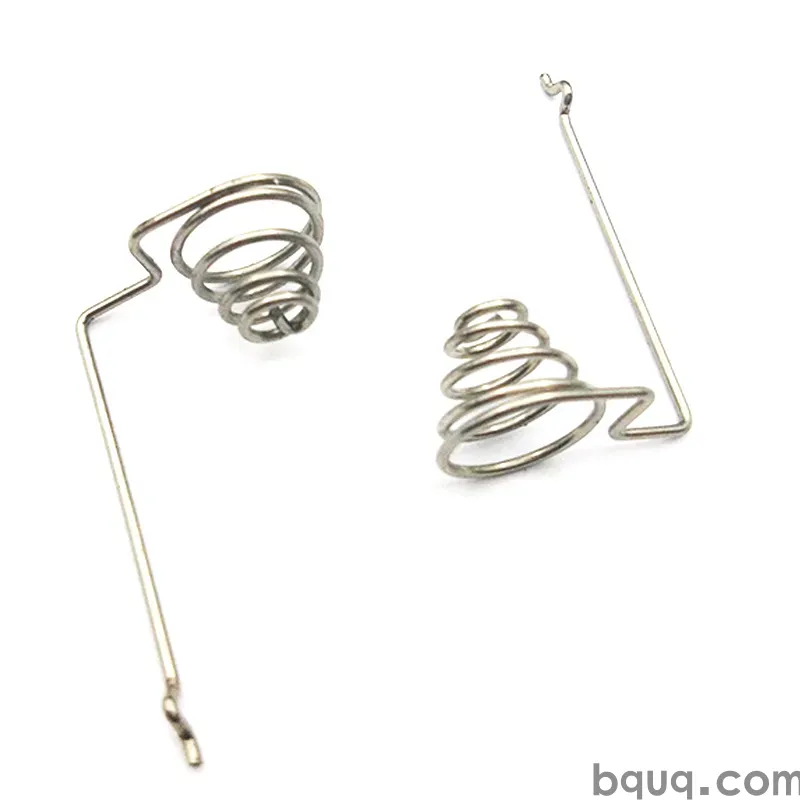
Torsion springs are coiled like compression springs but loaded by twisting the ends — the arms rotate around the coil axis and the spring stores energy in bending of the wire. They power door hinges, clips, ratchets and return mechanisms. Three things surprise designers: the wire is loaded in bending, not torsion, despite the name; the coils rub against each other as the spring winds, adding friction; and the arms carry high stress at their bends. Torsion springs also change diameter as they wind — the coil OD grows when wound in one direction — which matters when the spring sits in a close bore.
| Parameter | Torsion spring behavior |
|---|---|
| Wire loading | Bending stress (higher efficiency per wire) |
| Coil friction | Coils rub; lubricate or accept hysteresis |
| Diameter change | OD/ID shift as it winds — leave clearance |
| Arms | Bends at arm roots concentrate stress |
| End forms | Straight, bent, hooked, hinged arms |
Takeaway: torsion springs are the right answer for angular return motion and nothing else. When you choose one, leave radial clearance for the diameter change, design the arm geometry with generous bend radii, and specify torque at a working angle — the torsion equivalent of load at working height. For mechanisms that twist only a little, a torsion spring is often smaller than a compression spring doing the same job through a lever.
A Decision Sequence That Handles the Edge Cases
Walk the decision in order. First, what motion does the mechanism need? Push → compression family; pull → extension; rotation → torsion; nothing moves much but energy must be stored — consider a spring anyway or a different energy element. Second, what space exists? Axial room favors compression or extension; radial-only room favors torsion or a leaf form; tight compressed height favors conical springs. Third, how is the load delivered — flat ends, hooks, arms, or a mechanical interface? That decides the ends, which decide the failure mode. Fourth, check volume and environment: below a few thousand parts, all types coil on CNC formers without tooling; corrosion and temperature narrow the material list before they change the type.
| Requirement on the drawing | Spring type that fits |
|---|---|
| "Push with X N at Y mm" | Compression |
| "Pull with X N at Y mm" | Extension |
| "Return lever/hinge with X N·mm" | Torsion |
| "Fit in 5 mm compressed height, 15 mm travel" | Conical compression |
| "Hold a contact with X gf" | Small compression or leaf contact |
| "Absorb shock, rising resistance" | Progressive (variable pitch) |
Takeaway: when the drawing says force and distance along one axis, the type is already decided. When it says torque and angle, it is torsion. When it says nothing about motion — the classic failure — stop and ask how the spring is loaded before anyone quotes, because a spring built for the wrong loading direction will fail no matter how well it is made.
BQUQ makes all three families under ISO9001 in Dongguan — compression, extension and torsion — plus conical, variable-pitch and composite forms, so the type recommendation is not limited by what one line can produce. Send the drawing or a sketch of the motion with the load and space to sc@bquq.com or WhatsApp +86 13713157787, and the quotation within 12 working hours will state the recommended type and the reason — or tell you honestly when a non-spring solution fits better.
Email sc@bquq.com or WhatsApp +86 137 1315 7787 with your PDF/DXF/STEP file. An engineer reviews it and replies with price, lead time and DFM notes on working days.
Q: How do I know if I need compression, extension or torsion?
Look at the motion the spring resists: pushed together = compression, pulled apart = extension, twisted around an axis = torsion. The load direction is the whole decision — match the spring's natural loading and the design gets simple.
Q: Why are compression springs the default choice?
They are the cheapest to make, need no hooks or end connections to fail, accept the widest tolerances, and pushing is the most common spring job. Use them unless the mechanism genuinely pulls or rotates.
Q: When is a torsion spring better than a compression spring?
When the mechanism's natural motion is angular — a hinge, latch or return arm. A torsion spring stores that rotation directly; forcing a compression spring to do it through a lever adds parts and friction.
Q: What is initial tension in an extension spring?
The force required to start separating the coils, typically 10–25% of maximum load for close-wound springs. It holds the mechanism snug at rest. Drawings that ignore it get springs whose free length and working load do not match the mechanism.
Q: Can one factory make all three spring types?
A full spring line coils compression, extension and torsion on the same class of CNC machines with different tooling and end-forming steps. When the supplier runs all types, the type recommendation comes from the application, not from what the factory happens to sell.
Authored by the BQUQ Engineering Team. BQUQ is an ISO9001-certified source factory in Dongguan, China, running CNC machining, metal stamping, custom springs, heat sink and collet lines under one roof. Send drawings to sc@bquq.com or WhatsApp +86 13713157787 for a quote within 12 working hours. www.bquq.com